The word “myth” has always intrigued me; is myth defined by an absence of truth in a story steeped into the very foundations of a society, by the effect this absence of truth has, or by the interpretation its inhabiting society creates of a story? Is myth created elsewhere and henceforth adapted and believed at leisure, or is it a product of an authoritarian voice in society, pushed into action as social order and morale? What causes myth to transcend from fairytale? Salome, Lilith, King Arthur – even Rasputin and Sid Vicious – still live among us, it seems, resurrected by each generation in a new light reflective of its own condition. Why is that? And how does myth affect art and literature?
My curiosity in this stems from my interests in Victorian art, fin de siècle art, female representation, and today’s appalling mixture of current events. I find myself surrounded day to day by ideologies and moral fables – The Boy Who Cried Wolf, The Good Samaritan, the “Rags to Riches” tale of the American Dream – that hold such importance in society and daily living and understanding, but where do these stories and moral interpretations originate from? Do they change, and how would this change occur?
The femme fatale, to me, the most intriguing myth and trope of the late Nineteenth and early Twentieth Centuries, perfectly encapsulates this idea of “myth” considering its unique, yet timeless connection to its host society. Misogynistic representation at this time was birthed from the female-fearing breeding ground created as result of the Nineteenth Century sociopolitical atmosphere.
As I write my senior thesis on the Pre-Raphaelite Brotherhood and their connection to these tropes specifically, I have run across some interpretations that help me better understand this phenomenon, and have been able to write down my findings as so. Although this is only from my first, rough draft, I was too excited and enlightened not to share (so expect a cleaner, longer, more comprehensive version soon!):
Firstly, in order for any social and political history and its manifestation in art and literature to be explained, the definition that I am using in this argument of the word “myth,” the effect it has on a society, and where it originally stems from needs to be understood properly. In its simplest form, the word “myth” is understood as an “untrue story,” but we can more productively conceive of it as an explanation of the way stories are internalized and adapted in a variety of ways by society. In The Woman and the Demon: The Life of a Victorian Myth (1982), Nina Auerbach argues that “myth” has a more powerful relationship to its inhabiting society. She explains that certain ideologies, social norms, and usage of “lessons” from stories are what make simple tales and folklore transform from fairytale – feminine, subversive, fictional, dark, and way of escape and liberation for Victorian women – to myth – patriarchal, authoritative, sacred narratives that establish some form of societal structure, allegory, and conduct. Fairytales are merely a form of enjoyment, forbidden escape, and child-like wonder for women mostly, whereas myths are moral and contemporarily interpreted parables meant to shape a community and perhaps warn against ideals that have conflicting interests. Myths, in the Victorian era, also tended to be ancient stories either explained as a call for social order or authored by authoritarian men, while fairytales were authored mostly by free-thinking, dream-catching women for other like-minded women in hopes of challenging male-domonated order, without intent of the stories being translated as morally dense or as a socially reflective tale. Fairytales included tangible, liberated women, whereas myths would take those women as a more lofty, categorizable idea and proceed to strip them of their power and “devilish” intent for the betterment of society.
Because of this, myth, a word that provokes discomfort by sitting so perfectly between the unspoken and the authoritative narrative, holds more of an explanatory reflection of a time and political era than it is given credit for. Myth develops and births a legacy as result of the very environment it lives in, and is not just a lofty, intangible idea or tale that penetrates a culture and a people for no reason at all. It is like a parasite in need of a proper host to survive, one that will proliferate its meaning, exploit its original innocence and storytelling manner, and explain away its ambiguous details as ideas that benefit itself and suggest easy answers behind social fears. Without relatability or need for explanations and excuses, myth dies out and becomes a simple fairytale, a joyous, wonderful fable, with no authoritarian purpose anymore. Mythology is interactive with its host society, and works as an explanation for social questions. Myth lives on because of its staying-power and unique tenacity of its story’s contents.
Auerbach quotes Frances Power Cobbe, Anglo-Irish activist and leading women’s suffrage campaigner of the mid to late nineteenth-century, who explains myth as a universal nature that builds all cultures in the subconscious:
“The instant that day-light and common sense are excluded, the fairy-work begins. At the very least half our dreams (unless I greatly err) are nothing else than myths framed by unconscious cerebration on the same approved principles, whereby Greece and India and Scandinavia gave to us the stories which we were once pleased to set apart as ‘mythology’ proper. Have we not here, then, evidence that there is a real law of the human mind causing us constantly to compose ingenious fables explanatory of the phenomena around us, – a law which only sinks into abeyance in the waking hours of persons in whom the reason has been highly cultivated, but which resumes its sway even over their well tutored brains when they sleep?”
Now to connect this to the sociopolitical environment of the time, let us set the scene:
Misogynistic representation was birthed from the female-fearing breeding ground created as result of the nineteenth-century sociopolitical atmosphere: The average nineteenth-century middle class man was hard at work in the factory while his wife was at home with the family, so while the man took care of the secular aspects of the home, like work and industry, the woman maintained the family’s religiosity. This lessened male guilt about their seeming betrayal of religious and familial values that stemmed from this new industrialized society. According to the Western society’s understanding and modern rhetoric, women are to be trusted more greatly than men with religion, anyway, as they are more sentimental at heart and have an easier time fostering a connection to God. In The Young Ladies’ Class Book: A Selection of Lessons for Reading in Prose and Verse (1831) by Ebenezer Bailey, Principal of Young Ladies High School in Boston, it is stated: “To these high and holy visions of faith I trust that man is not always insensible; but the superior sensibility of woman, as it makes her feel, more deeply, the emptiness and wants of human existence here, so it makes her welcome, with more deep and ardent emotions, the glad tidings of salvation.” Here it explains that women have deeper emotional depth and awareness of human existence, leading to them being more open to religiosity.
Another example is found in the General Baptist Repository and Missionary Observer in 1840 stated about Mrs Frances Goodby, the wife of the Reverend J Goodby of Ashby-de-la-Zouch in Leicestershire, cited as an example of the ideal Victorian women: “… her ardent and unceasing flow of spirits, extreme activity and diligence, her punctuality, uprightness and remarkable frugality, combined with a firm reliance on God … carried her through the severest times of pressure, both with credit and respectability …”
Claiming women were more destined for religion and empathy was the only way, presumably, to negate male fear of religious and domestic abandonment resulting from the transition to a more secular lifestyle and being too busy industrializing the land to be involved as familially as previously expected. This justification for women’s involvement in everything domestic also soothed the male anxieties around the idea of “New Woman,” and how the public sphere started to incorporate more femininity, as women were taking on more public roles and requesting legal rights. This idea of sanctioned female spaces was dubbed the Cult of Domesticity.
The feminization of the home space made men feel emasculated just by being in their homes, enforcing the separate spheres even more. This familial system set a sense of order and standards to the average middle class family, and ultimately created a cycle of these ideals. Of course, while the world was rapidly changing and daily life was evolving due to the first wave of the Industrial Revolution, women were used as the defining, virtuous constant and a scapegoat to resolve the ever-growing male guilt. If one thing had stayed true and steady in the eyes of these modern working men, it was the meaning of true womanhood. No one dared tamper with the old-fashioned, beloved list of virtues that gave a lady her value, and a wife her purpose. They would blame the loss of virtue in the woman, herself, instead of blaming his newfound secular lifestyle. Piety, purity, submissiveness, and domesticity were the virtues, and society would not entertain any other ideas. Men would not face the reality of their own religious and civil downfall or work to reconstruct the society that they claimed to miss if it meant reinstating the responsibility of men to be pious and pure.
Religion and purity were also valued in a woman particularly because it did not remove her from the home, and rather kept her confined to it. This comforted men as this meant there would be less women, if any, to be found in public spheres such as in politics, the workforce, and the like, threatening male authority and dominance. In addition to these fears, arguments of biological inferiority claiming that women were incapable of properly involving themselves in politics, commerce, or public service, were gaining the attention of the general population. Men were seen as active contributors to society because of the lack of reproductive responsibility they had, unlike women who were, according to the general understanding of the time, naturally sedentary and bound to the home as result of their constant relationship with reproduction, such as menstruation, pregnancy, and child-rearing. Men were only concerned with fertilization, and had much time to spare. Because of these ideas, fear of hormonally charged insanity sparked additional fear of women taking public roles, as menstruation was considered a time of irrationality, debilitation, and illness.
In addition to these anxieties, the sexuality of women was greatly feared in the Victorian Era. In the earlier half of the century, women were seen as fragile, docile creatures with little to no sexual appetite, usually a vessel for sympathy, with no means of blame or intent of harm. Men, lustful and incapable of controlling their naturally driven desires, were seen as taking advantage of the innocence and lack of desire in women. The Pre-Raphaelites, specifically, as will be explained later on in detail, are one of the mid-century Victorian groups that pushed a narrative to transform these saintly, victimized women into this new, rather bizarre feminine type. Walter Houghton, American historian of Victorian literature explains that “the sexual act was associated by many wives only with a duty,” and to their husbands, nothing but a mere act of nature and pleasure. As the century progressed and the cult of domesticity dug more deeply into the very roots of society, this ideal flipped around, and men, now the fragile, well-meant beings, were pitied for falling victim to the propositions and advances of devilish, sinful, lowly women, more often than not blamed for the sinful acts of the man, and not the man himself. Female sexuality was also associated with lack of class and the stripping of one’s dignity, with respectable women ideally representing the essence of asexuality, while it was standard in women below the standard. This shift occurred because of the idealized piety and purity in bourgeois women in the latter half of the century, and a sexually charged woman was a threat to the cult of domesticity and civil standards enabling men to maintain authority. Nathan G. Hale Jr. explains in Freud and the Americans: The Beginnings of Psychoanalysis in the United States, 1876-1917 (1971), “Many women came to regard marriage as little better than legalized prostitution. Sexual passion became associated almost exclusively with the male, with prostitutes, and women of the lower classes.”
Some doctors were so convinced that women had absolutely no interest in sexual activity, that they claimed if they showed any signs of it, they resembled a man. Later on, other doctors acknowledged the existence of female sexuality and pleasure, and claimed that if pleasure was not found, by means of a man or some other outlet, it could lead to a build up of frustration and weakness. Medical writers stated that this resulted in hysteria, mania, and insanity. Dr. William McLaury wrote in The American Journal of Obstetrics and Diseases of Women and Children (1887): “Females feel often that they are not appreciated that they have no one to confide in; then they become morose, angular, and disagreeable as a result of continual disappointment to their social and sexual longings. Even those married may become the victims of sexual starvation when the parties are mentally, magnetically, and physically antagonistic.” Henry Chevasse, another medical writer and voice of the time, agreed with this idea, explaining why nunneries were notorious as places of fanaticism: “Hence the old proverb, ‘The convent and the confessional are the cradles of hysteria and nymphomania.’” One way or another, female sexuality was villainized, and hysteria was a common explanation for uncontrollable women, disobedience, and prostitution, as they were the ones who threatened the social order idealized by the cult of domesticity.
The myth of the devilish, desperate, frenzied, and forlorn woman was created as a result of these various fears centered around women and their sexuality.
And here is my little rundown of the femme fatale:
The femme fatale can be seen as the very same woman as the femme fragile or the fallen woman, but inside an erotic escapist fantasy. She opposes the asexual, childlike tale of the femme fragile, the portrayal of repression, in addition to the subjection to social repercussion of the fallen woman. She lives beyond Victorian life, unlike the last two tropes, direct applications of ideals and consequences. As an imaginative, erotic symbol of vengeance and terror, she displayed male fantasy that could only live outside of daily life.
These femme fatales tempt men in gardens in the bible, are pinned up on World War I propaganda posters, and are plastered across the film noir silver screen. Although this villainous trope highly reflects ideas of the Victorian era and the fears of female sexuality, the femme fatale as a specific categorizable term was properly implemented in the late nineteenth-century. Earlier examples can be seen in French literature and poetry during the 1840s, which was adapted by the English by the 1890s. Some argue that the idea stemmed from even earlier origins, such as the eroticism of Johann Wolfgang von Goethe, a German poet, playwright, and novelist of the Eighteenth Century. Nonetheless, the archetype is pinned to the art and literature of the fin de siecle for the most part, and was a social reflector and patriarchal projection for the times. The French Decadence, an extravagant Modernist era following the Victorians and the Romantics, is widely known for utilizing the sensuality and artificiality of the femme fatale, as well, though only somewhat redeeming it of its negative connotation with modern ideas of artistic rebellion and permitted female sexuality.
Italian scholar and critic Mario Praz in The Romantic Agony (1933) and author Patrick Bade in Femme Fatale: Images of Evil and Fascinating Women (1979) argue that the archetype of the femme fatale is the counterpart to the Byronic literary hero figure of the 1800s, a term for a male archetype coined after English Romantic poet Lord Byron, known for his moody, pretentious, dark, and brooding anti-hero characteristics. “He bears many of the same features which were later to characterize the femme fatale. He is pale, impassive, mysterious, with a mirthless smile, and a dangerous magnetism”, states Bade (1979, 10). Both archetypes are magnetic and mysterious, but the femme fatale holds a more sinister allure. Of course, this specific profile was only pointed out once the femme fatale received her sultry nineteenth-century-specific nickname and was proliferated through French and English literature. However examples of women being portrayed as so is evident throughout history, and the femme fatale trope claimed and categorized these past stories and mythologies into a singular, modern stock-character, instead of respecting them as the multi-faceted, deeply intellectual, and historically unique characters they are. Women, through this archetype, were extracted from their entire personality and legacy, and all remembered about them was their sin and fatality.
The archetype can be found in ancient and modern literature and mythology alike, myths that highlight devilish, wicked temptresses who lead protagonist men to their death. Examples of these are Circe and Sirens, Greek Hera, Aphrodite, Indian Kali and Durga, Nigerian Oya, Polynesian Pele, Sumerian Inanna, Egyptian Hathor, Celtic Queen Mab, and later Biblical Lilith, Eve and Salome. Ancient femme fatales such as Inanna, Kali or Hera, although feared, according to the mythology, were still worshipped and respected, whereas femme fatales from monotheistic religions were promptly expelled and diminished, such as biblical Eve and Lillith.
Fierce and powerful women were once upon a time perceived respectfully as omnipotent, almighty, and givers and goddesses of life and death. Ancient mythologies likened women and their feminine qualities to their gods of creation and nature. The mother of Earth itself was the goddess Gaia, according to ancient Greek mythology. Over time, however, as the patriarchy emerged throughout many areas of the world, powerful women and their independent and influential feminine traits received their dangerous and evil connotation we are familiar with today, hence the modern femme fatale trope. As authors David Leeming and Jake Page say in Goddess: Myths of the Female Divine:
Female power, as represented by the new worldview in the figure of the femme fatale—the Sirens, Harpies, and witches of myth—was feared and had to be controlled. The cult of virginity would emerge as a means of ensuring male ownership and would become an important factor in the overthrowing of the matrilineal economic system of the Neolithic cultures.
Writers and storytellers of modern times, such as Charles Baudelaire, Bram Stoker, and Edgar Allen Poe are known for their indulgence in the idea of the villainous femme fatale, and can be seen as some of the popular culprits for the widespread cultural hysteria of the femme fatale during the nineteenth-century. In Baudelaire’s Danse Macabre, he likens death to an extravagantly dressed prostitute, performing among desire-stricken men filled with untainted life and prideful youth, now at the daring mercy of Death herself. “Her eyes, made of the void, are deep and black; / Her skull, coiffured in flowers down her neck, / Sways slackly on the column of her back, / O Charm of nothingness so madly decked!”
Emphasis is put on how Death holds no emotions of her own, rather evokes them in her male victims. The common trope of the emotive, flaunting, and dangerously alluring nature of the femme fatale is also used:
Do you come to disturb, with your powerful grin, / The feast of Life? Or is it some ancient fire, / Spurring still the living carcass you dwell within, / Pushing you, fool, to the Sabbath of Desire? / With songs of violins, with candles’ glow, / Hope to tear your taunting nightmare apart? / And implore the orgies’ ferocious flow / To cool the hell enkindled in your heart?
Baudelaire, with his lyrical expression of desire and fateful doom, highlights the mid nineteenth-century ecosystem and how middle and upper class women are viewed as asexual maidens of the home, and working and lower class women as energetic, lively, and sexual. “Yet, who has not clasped a skeleton with passion, / And who has not fed on things of the graves? / What matter the perfume, the raiment, the fashion? / He who feigns disgust, his own beauty craves.” He begs the question: if she is so barren of flesh to be “fed on” and so empty of life, a femme fatale symbol of a ghostly trap, is the sin the woman or the desire? Is the woman at fault for tempting, or the man for being tempted? Is the very desire what makes the man the tragic hero who danced with Death by no fault of his own? The trope of the femme fatale was an easy way for men to mitigate fault and shame of desire. In Baudelaire’s World (2002), Rosemary Lloyd discusses how Baudelaire had a habit of blaming the women in his life for the consequences of his own actions and suffering.
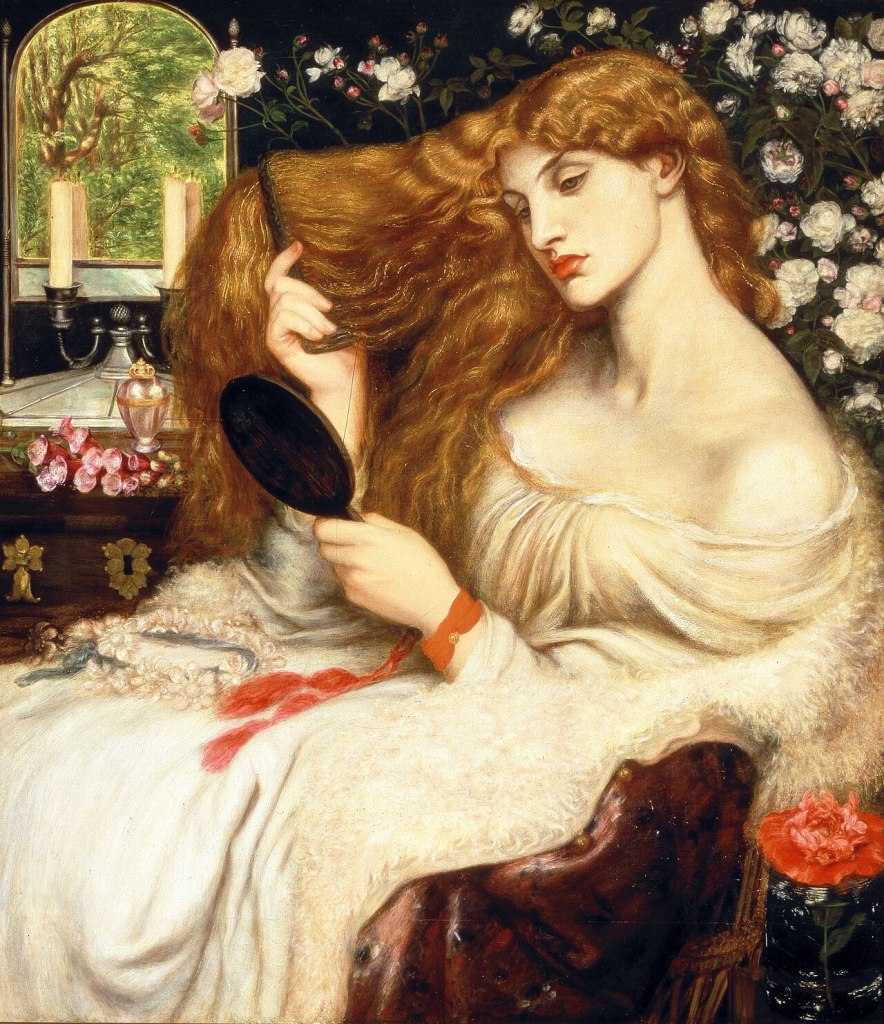
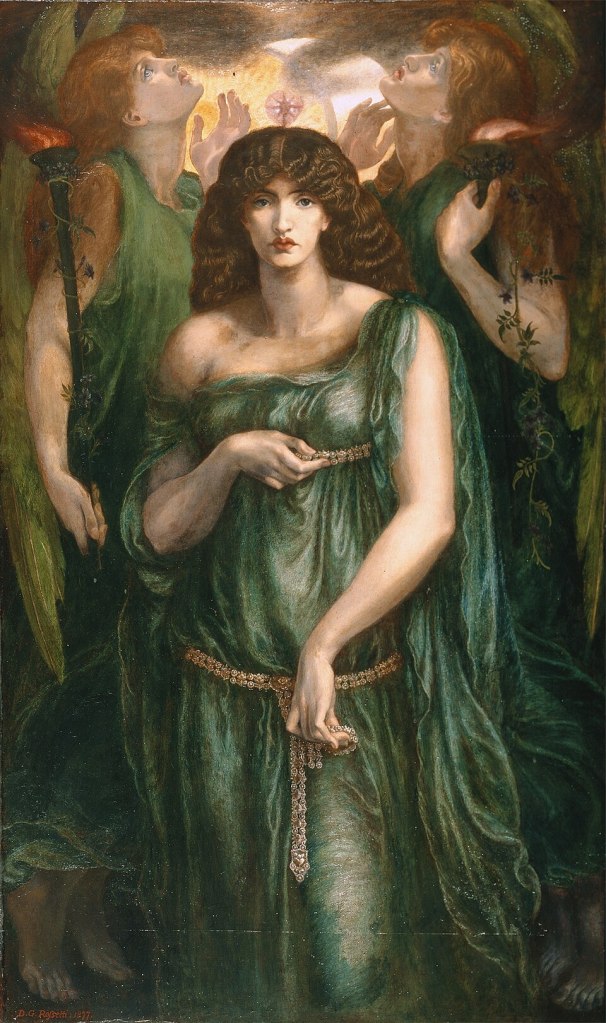
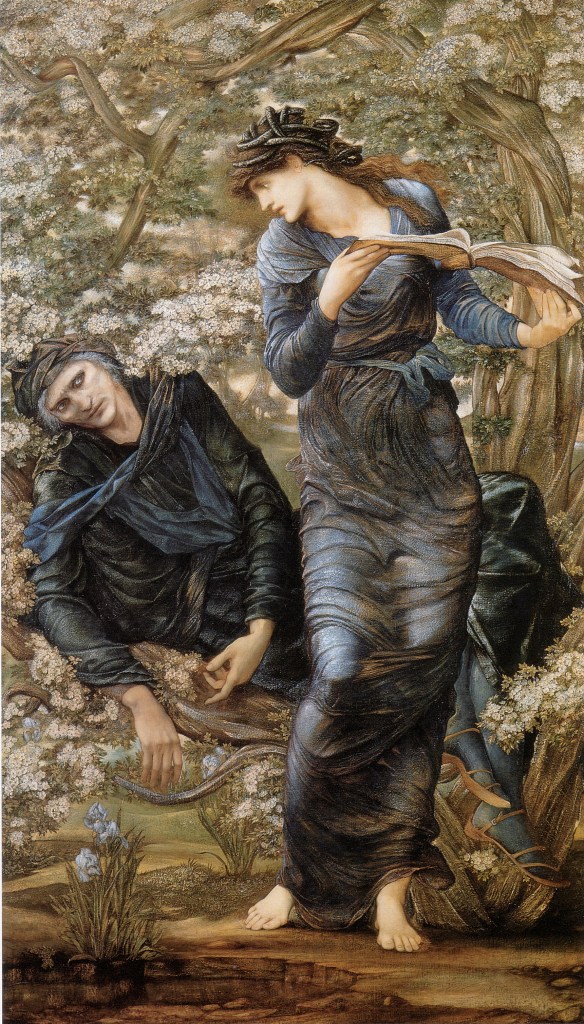
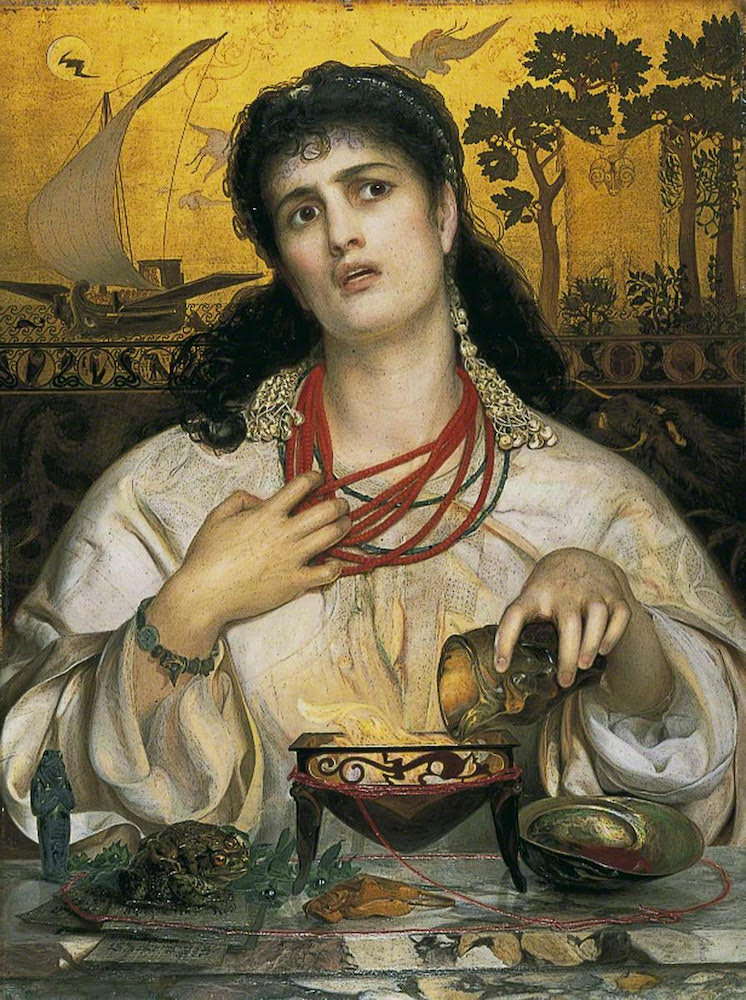
Here are some Pre-Raphaelite artworks that best capture the femme fatale in all her demonic glory:
(Keep in mind that red hair was viewed during this era as symbolic of prostitution, rage, and uncontrollability, and the Pre-Raphaelites were the first to use this to their artistic and rebellious benefit in a manner different from their Victorian counterparts.)