
Origins and woes of Avant-Garde sapphic Parisian artist, Marie Laurencin

Seamstress Pauline Laurencin and Deputy of the French National Assembly, Alfred Toulet, met in 1883, the very same year Toulet ran for office. From this unwed, unlawful relationship, sprouted young Marie, sweet, sweet Marie, on October 31, 1883, in Paris.
Only at the age of twenty-one did she meet her father; he was too ashamed of his taboo adultery to have proper regard for his child, and only held responsibly for her schooling. She’d been aware of this man, of course, since he’d visit here and there, despite being highly unwelcome by her mother, Pauline, but only later had she learned of their kinship.
Marie lived alone with her mother, a controlling and emotionally distant character in her early life. Although she approved of her daughter’s education and schooling, she vehemently discouraged Marie’s artistic inclinations, going as far as destroying some her drawings. All she wanted – and wanted very clearly – was for Marie to be a schoolteacher one day.
Academically challenged, artistic, distraught and insecure, Marie spent her teen years balancing between few means of support. Being a schoolteacher, although only her mother’s dream for her, had become a dream unfeasible, regardless. Marie had described herself as “sad, ugly, and devoid of hope.” Nonetheless, she excelled at drawing, and kept herself exceptionally well-read all around.

Examine her facial expressions (or lack thereof.) What kind of relationship did Marie and her mother seem to have had from Marie’s portrayal of her?
With growing talent for the arts, she attended a municipal drawing school in Paris’s Batignolles neighborhood, École de Sèvres, studied porcelain, then attended Académie Humbert in Paris in 1904. Her works were criticized for being narcissistic, especially since many women she portrayed looked alike to her, with soft, silky porcelain skin. Art critic Roger Allard held the prominent voice in this argument.
“An egotistical and charming art hers…which re-lates everything to the self. She had scarcely any subject other than herself, nor any curiosity than to know herself better…the whole of nature for Marie Laurencin, is but a cabinet of mirrors,” claims Allard.
Wouldn’t this just be a consequence of a lonesome childhood, with many years of sketching and perfecting her own reflection in the mirror?
One of her earliest works, Chanson de Bilitis (1905), stands as an ode to Pierre Louÿs’ essential and highly vital erotic sapphic text, The Songs of Bilitis. Chanson de Bilitis must have been subsequently connected with her affiliation to Le salon de Natalie Barne, a sapphic literary salon in Paris, a social gathering space for sapphic artists, musicians, and writers. Free spirits, if you will. Discussions would involve topics of arts and literature, and their relation to female desire. In the early twentieth century, the sapphic community defined themselves as women who were romantically connected to women, contemporary terms such as lesbian and bisexual had not been integrated into common jargon quite yet.


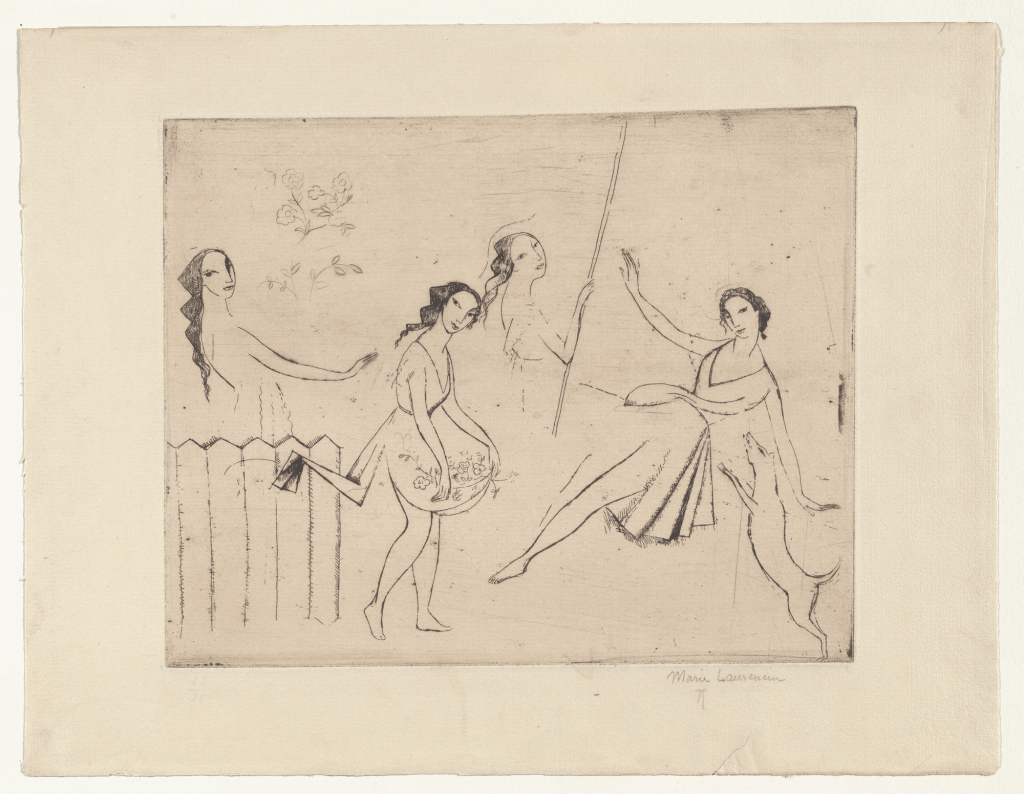
Laurencin had been introduced by Pablo Picasso to poet Guillaume Apollinaire, with whom she connected deeply with and shared many similarities, including the fact that they were both illegitimate children. Their relationship lasted a total of six years, and ended around the same time Laurencin’s mother had passed.
There is a common story templated by generic history tellers of struggling women, and their male counterparts who introduce them to the wonders of life and the goodness of the universe, hereby opening doors, literally and metaphorically, that supposedly, they could never have opened themselves. Marie Laurencin makes one reconsider these preconceived impressions.
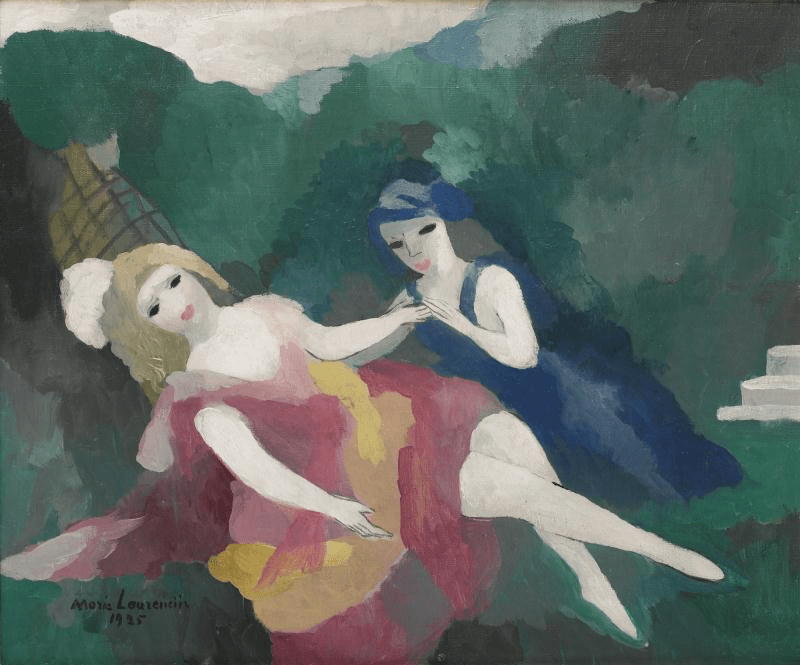
Le Calmant (The Sedative), by Marie Laurencin, was first published in the 391 Magazine, No. 4 in Barcelona in 1917
“More than annoyed
Sad.
More than sad
Unhappy.
More than unhappy
Suffering.
More than suffering
Abandoned.
More than abandoned
Alone in the world.
More than alone
Exiled.
More than exiled
Dead.
More than dead
Forgotten.”
“Plus qu’ennuyée
Triste.
Plus que triste
Malheureuse.
Plus que malheureuse
Souffrante.
Plus que souffrante
Abandonnée.
Plus qu’abandonnée
Seule au monde.
Plus que seule au monde
Exilée.
Plus qu’exilée
Morte.
Plus que morte
Oubliée.“
 Earth As My Guardian