
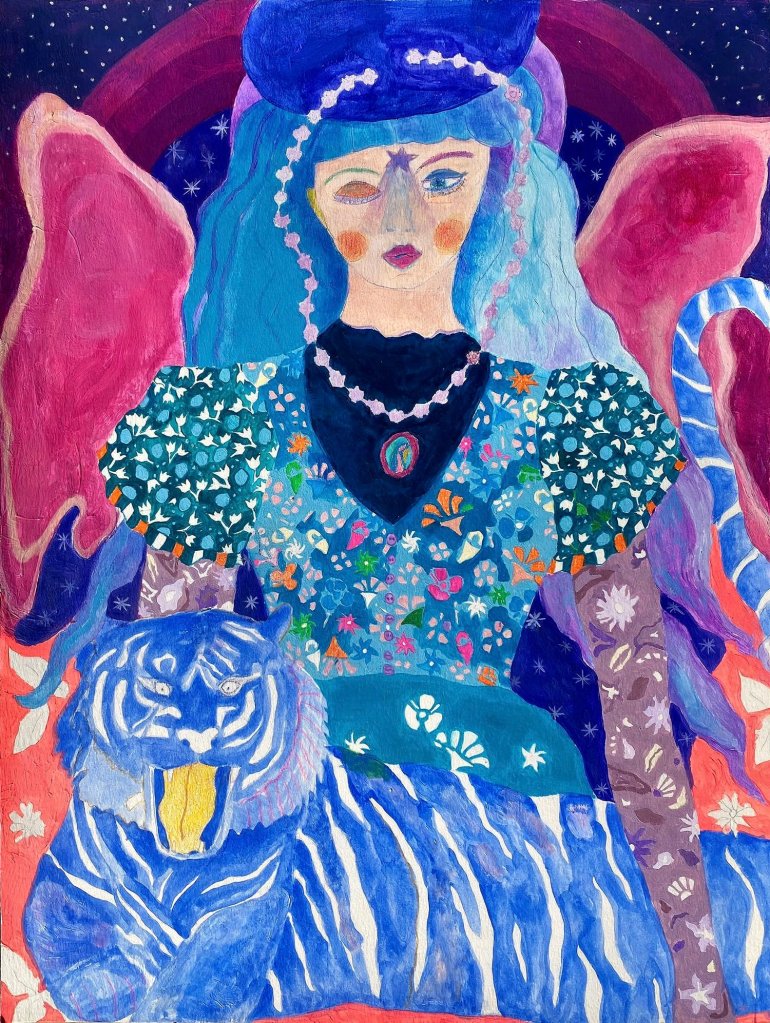
Spiritually keen medieval and Renaissance enthusiast, Gabriella Mazza, is an Italian born artist, studying as an art history MFA/MA candidate at SUNY Purchase. She studied previously at New York Academy of Art, SVA, Cooper Union, and the New York School of the Arts. Recent converter from Sicilian Catholicism to Tibetan Buddhism, now a devotee of Paramahansa Yogananda, the father of Yoga in the West, Mazza has examined, internalized, and committed her lifestyle to the mysteries of existence and the meaning of life.
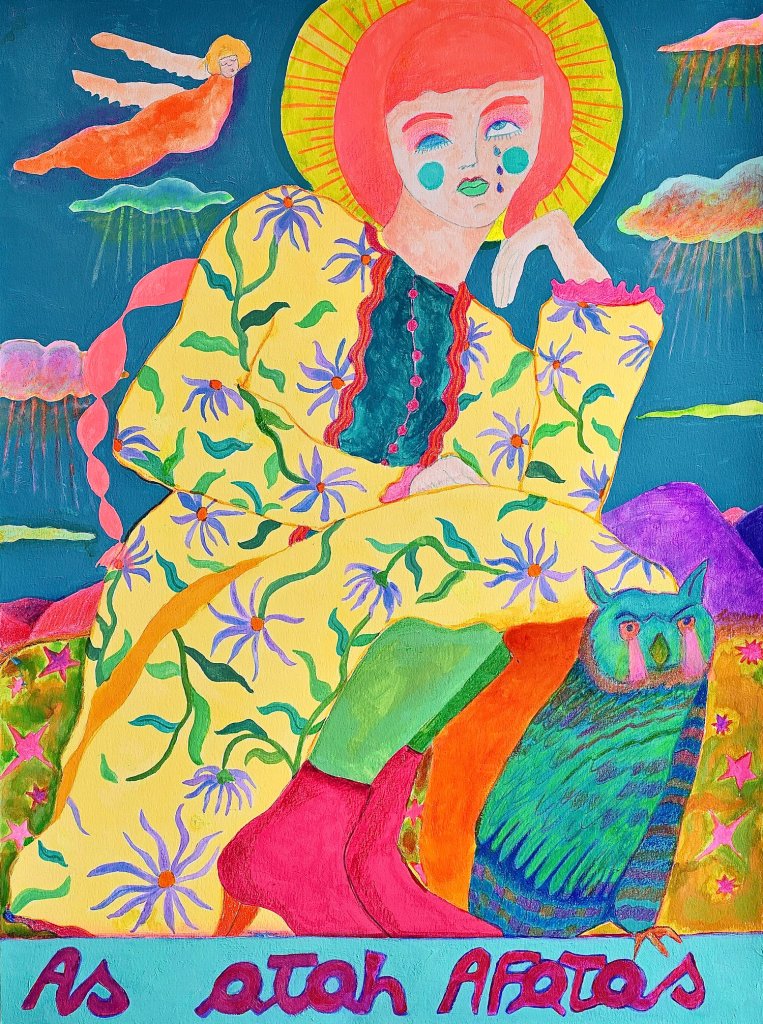
“There are several astral worlds,” Mazza explains. “Astral planes depending on the level of a spiritual development. The way Yogananda describes the higher realms of the astral plane is that senses are heightened. It is like this world, but much more beautiful.”
Intuition leading her painted characters into fruition, Mazza contemplates the fact that she finds herself painting…herself. The astral plane beyond this practical world seems of higher grace and intellect to Mazza, and in a somewhat escapist manner, she pictures herself within it. She laughed while she said: ” I don’t want to be here. I want to be on top of a cloud hanging out with other angels.”
While working on her pieces for the MFA art exhibition Time Trap, an overall goal of hers was to evoke the tangibility of the astral plane in the viewer, yet subconsciously, the experience of creating had been just as summoning for her, as well. Stepping back from the canvas, she sees a self-portrait painted among the planes. She has not failed at her goal in the slightest; rather, she’s become the living example of it.
Being raised in Sicily, Italy, Mazza learned to equate religion with martyrdom and suffering, and discusses her experience at her childhood Church. “You’re not supposed to have fun, you know? You’re supposed to suffer and repent, and a lot of these churches have tombs on the main aisle and you’re walking on tombs…which is, a little scary.”
Competing with the narrative she had been given all her life of the need to expiate to be eternal, Mazza found a resonance in Tibetan Buddhism, and began a routine attendance at a meditation center. Life is supposed to be blissful, she learned. Tragedy does not define a person, nor give them any higher form of spiritual being or worth. Live satisfyingly, and work out your karma. Believing in God should not equate to turmoil, and when it does, it is being done wrong.
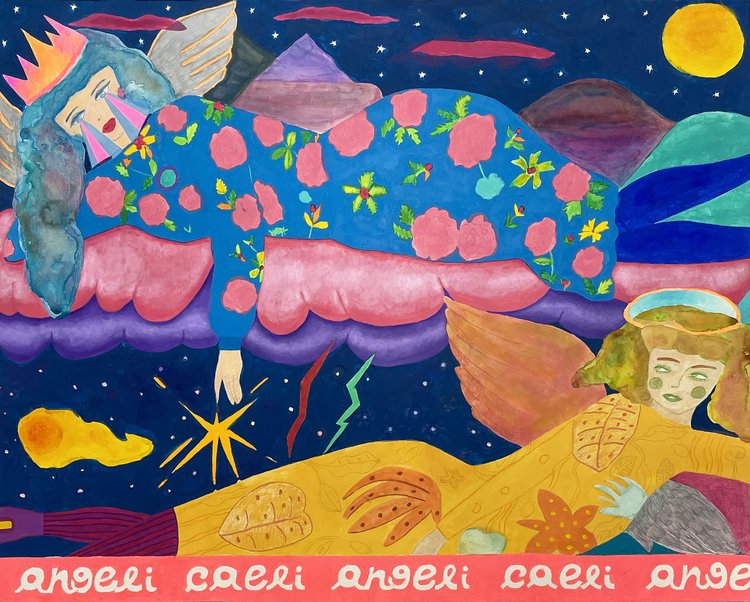
Mazza continues to explain how Yogananda teaches about Divine Mother, a figure playing a role akin to Mother Mary, the feminine part of God. Similarly, Divine Mother is the artistic feminine portrayal in Mazza’s work, whom she projects masterfully in her own imaginative astral realms. Divine Mother is parental; She is aware of our precarious state and what is or is not for our own good.
“But at the same time, and you’ll see here, there is a contradiction because I do get angry at God because I don’t understand why we have to go through suffering to achieve spiritual progress.”
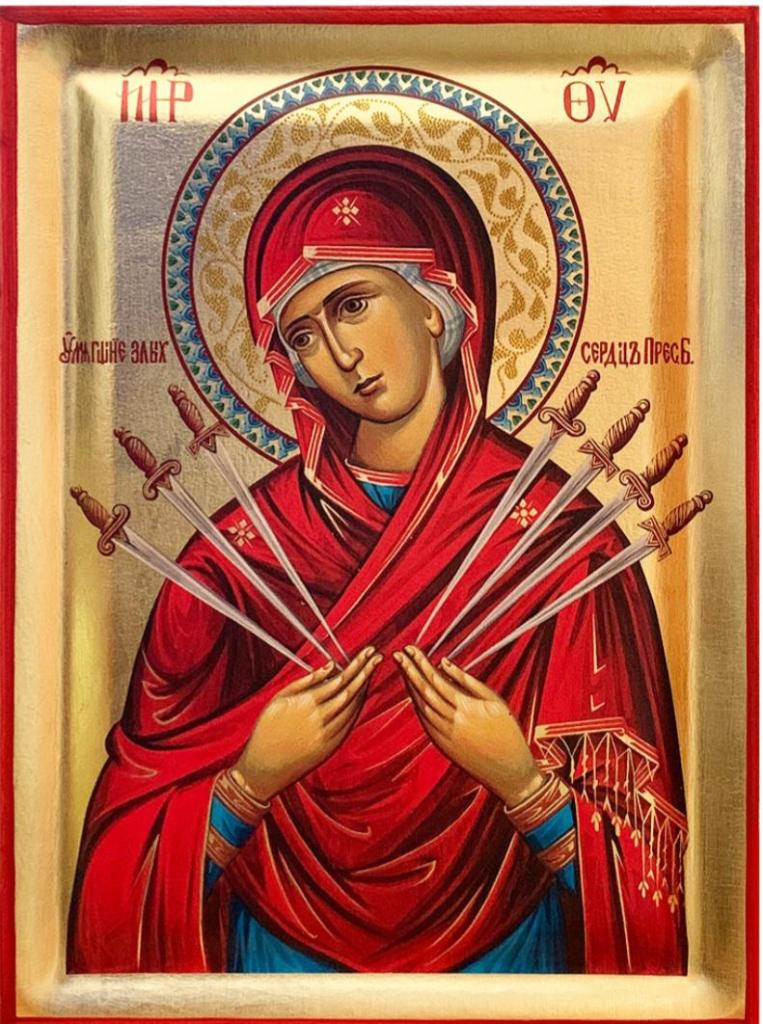
A comparison capturing this attitude comes to her mind: The humanity of Divine Mother and Saint Sebastien, both portrayed in Christian iconography as punctured by arrows. This particular half length icon is one of the few depictions of Most Holy Theotokos (Mother Mary) without the Christ Child. The stars above Her head symbolize Her innocence and divinity, and She is garbed in her classic attire of blue and red. Mazza reflects on the necessity of adversity, and how we all must to endure its subsequent pain in this realm. The lingering question concerning fairness behind physical “punishment” leaves us with varying answers constructed to sooth our nescience. One day, Mazza hopes, answers will come to light, filling gaps in our examinations of existence and meaning.
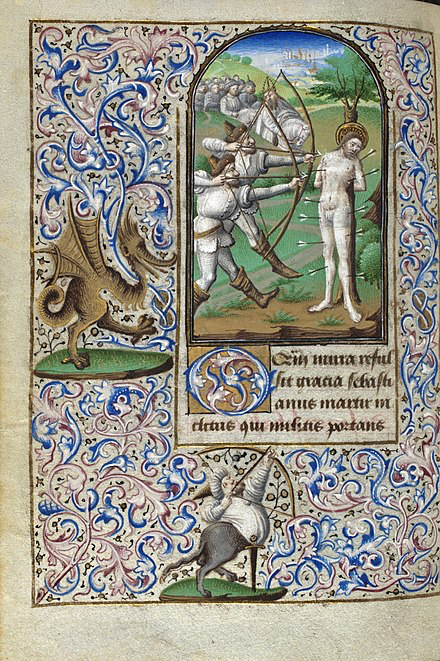
“ I was told that our brains aren’t capable of understanding those stuff. It’s like, too much. We just have to accept it. Although I have to say that when you put reincarnation in the picture, a lot of questions are answered…a lot of questions about why the world is a certain way…”
Along with medieval and Christian iconographic inspiration, Mazza is also inspired by fauvism, the Pre-Raphaelites, Russian fashion design, and contemporary fashion design, such as Anna Sui. Many of her characters are dressed in patterns by Sui. To Mazza, glamour is feminine, and the world is, too.
As for the art, the process is unmatched. Her technique can be brought down to ideas and concepts of process. Beyond the basic form, foundation, and composition, her caricatured entities and diaphanous angels generate in her work throughout the actual art creation, unlike many artists who have set in stone blueprints of their beloved subjects and characters. Though Mazza’s deities she portrays are not in the slightest way less beloved by her, her art evolves through impulse, intuition, and ingenuity. The choice of irregular colors and an overall otherworldly palette, says Mazza, is a result of momentary gut feeling and the need to fill in gaps.
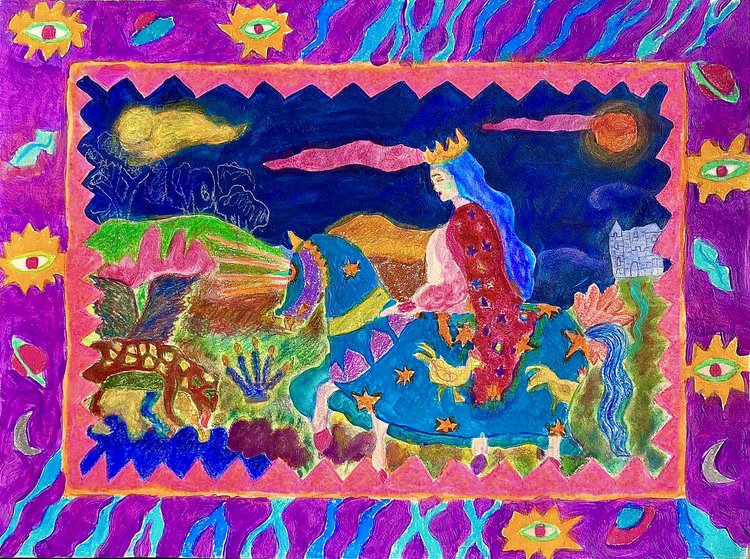
The following is the blurb I wrote for the SUNY Purchase MFA Group Exhibition Time Trap,curated by Gregory Wharmby, Julian Kreimer, and Melissa Forstrom, where Mazza’s work was showcased.
“Visualizing the celestial world of the divine feminine and ethereal, Mazza pictures herself through choices of colors, patterns, and calculated compositions of spiritual deities. Robed in garments inspired by fashion designer Anna Sui and contemporary fashion, these angels live life atop our world in the astral realm, depicting notions of a feminine, nurturing, Elysian God. Colors that are particularly foreign to earthly nature – such as bright neons, eccentric pinks, peacock blues – are used, emphasizing the divinity of godliness, loftiness, and the non-mundane glamor within femininity beyond the physical. Converting to Tibetan Buddhism, a contrast from her Catholic childhood, these airy depictions display a reclamation of a reborn spiritual being and identity through an esoteric, mystic, and feminine realm past this world.”
Check out Gabriella Mazza’s website:

