
The French explicitly animated American fashion design from the late nineteenth century until the era of Art Deco, in the early 1920s and 1930s. This inventive, drastic shift to Americana design is displayed at the MET’s Jazz-Age Silks: The Stella Silks Americana Collection exhibition, on view from March 25, 2024 to April 15, 2025.
A newly hired art director for the Stehli Silks cooperation, Kneeland L. Green, visited the International Exposition of Modern Decorative and Industrial Arts held in Paris in 1925, leaving deeply inspired by the trip. He then kicked-off a solely Americana influenced print line, showed throughout the exhibition. Separation from French fashion traditions — a defining shift in American identity presentation— sparked new influences in the international fashion industry, as well.
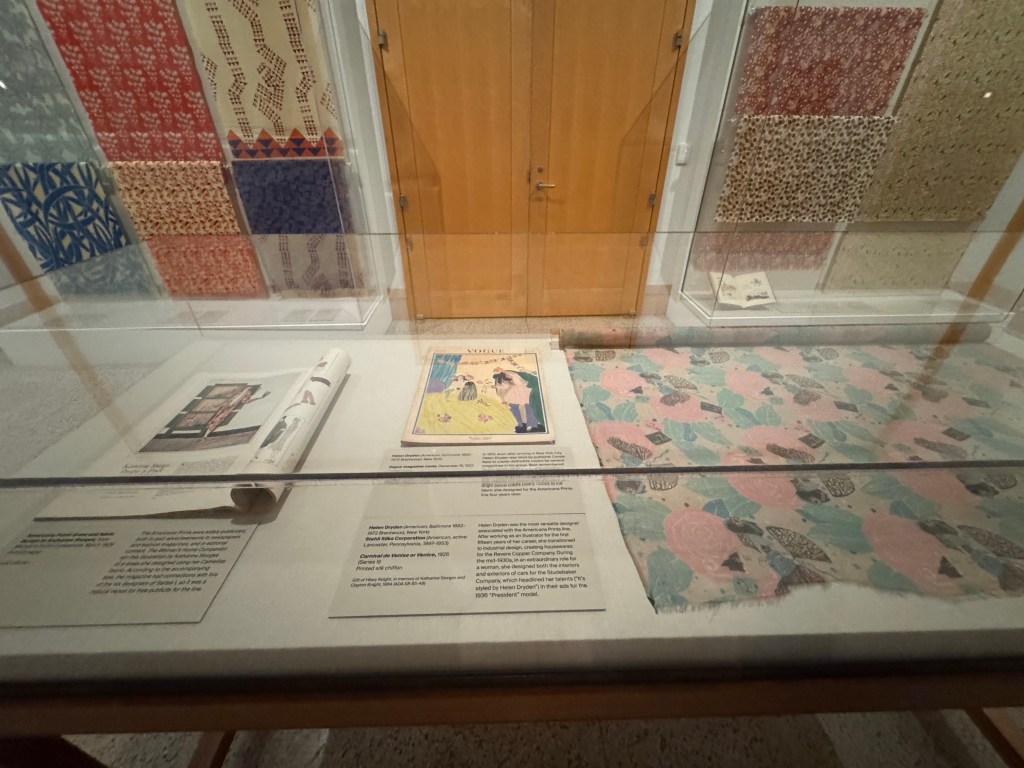
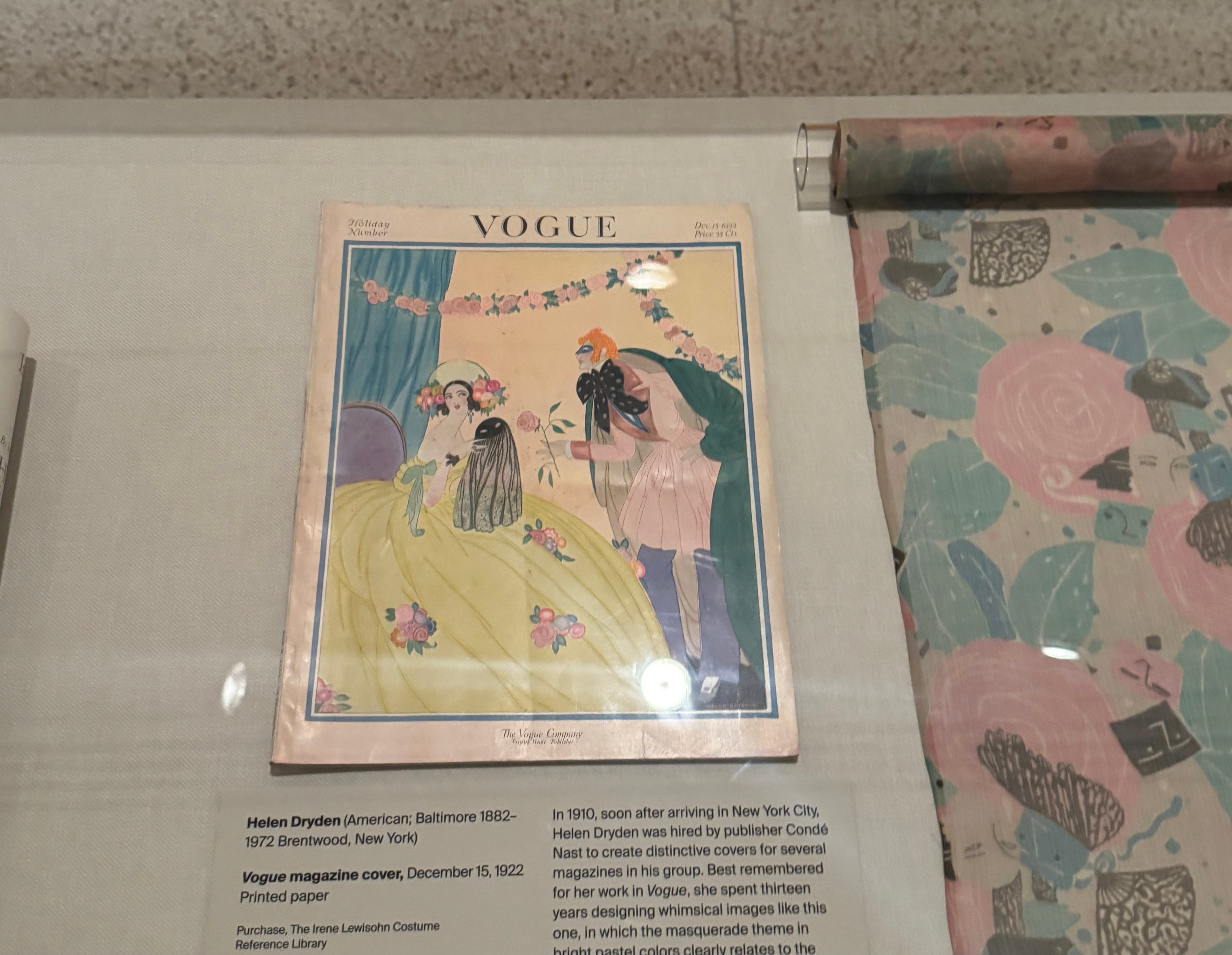
Green hired American artisans to combat contemporary traditional, mainstream manifestations of American lifestyle that he found to be simply untrue, cynical, and pessimistic. The termination of reliance on European styles, to Green, was the solution. He believed this much-needed split from uninteresting Greek patterns and conventional florals to be a proclamation of empowered American identity and optimism after world-wide strife.
Philosophical break down of the exhibition:
I personally think that this is considered a process-based interpretation, considering the exhibition does not solely focus on the techniques and craftsmanship of the works, but rather the overarching themes and statements made by the pieces as a collection, and leaves room for viewers to engage and take away what they please from said pieces.
Christopher Whitehead, who runs the Art Museum and Gallery Studies postgraduate program at the International Centre for Cultural and Heritage Studies, Newcastle University, UK, discusses differences between methods of interpretation in museums, and describes two categories: product-based and process-based interpretation. Through his analyses and philosophical texts, he emphasizes the importance and inherit strength of process-based interpretation over product-based interpretation. According to Whitehead, process-based interpretation has a higher participational aspect to it, versus interpretation which is product-based, with a fixed meaning already defined, without viewer cooperation. The process-based method leaves room for open-ended questions wrung out from the visitors’ minds, without creating a set authoritative meaning that cannot be dispensed, warped or perceived in any other way.
Creating exhibition interpretation in a product-based manner can make the space feel uncomfortable and complicated, especially considering that viewers are probably non-experts, such as children, tourists, and students. This can lead to the pushing away of viewers, in fear that they do not belong.
As Whitehead explains, “Process-based interpretation might function, in other words, to ‘ground’ art, removing it from the transcendental sphere which arguably works to exclude those visitors who have not internalized the kind of map of objective, stylistic, technical and educational relations which has structured most art historical study in the modern period and today” (Whitehead, p. 42). Here, Whitehead emphasizes the alienation of non-experts and how process-based interpretation can transcend these preconceived notions of the museum atmosphere, space, and information. An example of a process-based interpretation that Whitehead cites is the Kelvingrove Art Gallery in Glasgow.
“One way of ‘opening’ museum interpretation is the posing of questions (see Rand 1990, Litwak 1996, Hirshi and Screven 1988 and Bitgood 2003). Many labels – especially those intended for family audiences. This can be exemplified in the following example at Kelvingrove Art Gallery in Glasgow pertaining to Anne Redpath’s oil painting Pinks: ‘This painting has very vibrant colors. Anne Redpath was interested in the effects colors have on mood when they are placed beside each other. How do these colors make you feel?” (Whitehead, p. 43).
 Earth As My Guardian