

Venus at her Mirror, or more commonly known as The Rokeby Venus, painted in 1647, is a stunningly positioned, lightly saturated, highly voyeuristic work by Diego Velazquez, his only surviving portrait of a female nude. He was the pioneering painter of the Spanish Baroque period, appearing within the movement a decade or so after the death of Caravaggio. His status as primary painter for the court of King Philip IV halted some of his own stylistic expression throughout his career, as he stayed loyal creatively to the king’s needs, which remains evident throughout his chosen symbols and motifs. He was well liked by the king; the pair’s relationship was far more personal than the typical artist-patron dynamic of the time, which granted him higher positions within the court’s administration, and overall, indirect protection from the law.
There is a beautiful harmony in this painting between each figure, each fabric, and each decoration, while still giving them all enough character to hold a story of their own. Cupid, painted to the left, graciously presents a thick-framed square mirror to the Goddess Venus, who is sprawled across her bedding dramatically with her back facing the viewer. The eerie, yet soft effects of the lighting creates an illusion of a shimmering glow reflecting off her body. With her right arm holding her head, and her left pressed against her body, we feel a sense of relaxation and ease, although the lighting on her figure contradicts this with a sentiment of coldness. It feels theatrical, performative, and carefully positioned, as if it were a photograph taken of a play on a theater’s center stage, and yet it has a softness regardless.
Velazquez’s usage of lighting here holds many similarities to the choices of Caravaggio, in the way the spotlight presents its actors, and the brash, overhead shadows enlightening them. Both artists seem to pay extreme attention to where and how they place light sources onto their prime subjects, and how this light interacts with the scenery. Velazquez’s style, like Caravaggio’s, embraces the “chiaroscuro” technique in a more subdued manner, enhancing depth and form in the canvas instead the harsh boldness “chiaroscuro” is more conventionally known for.
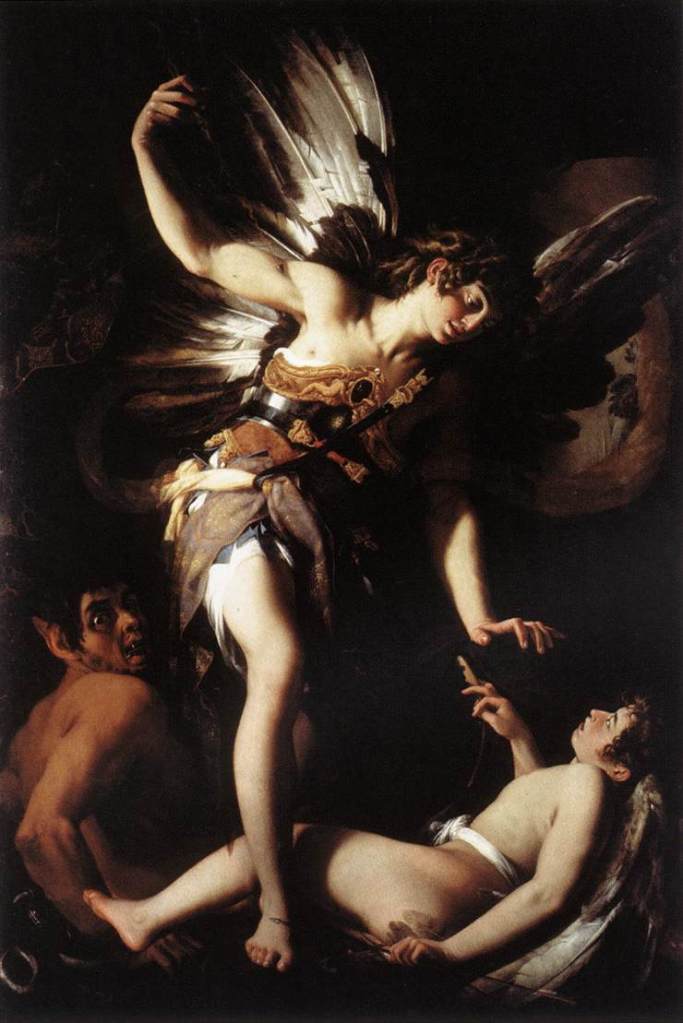
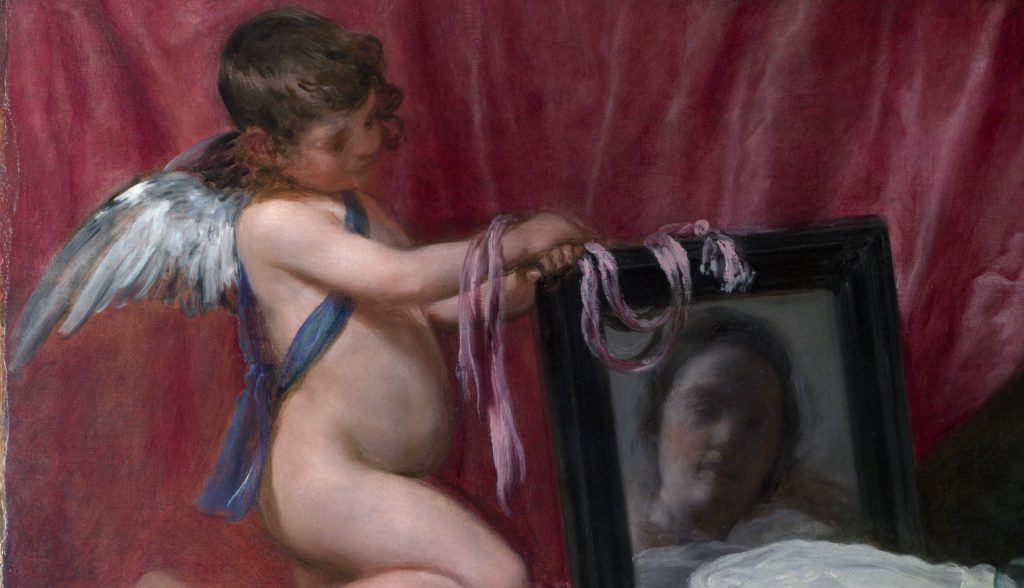
Venus’s back, torso, and legs are elongated, accentuating her figure slightly. Although elongated, she does not read as disfigured at all; she looks posed, still, and motivated. This particular creative detail works perfectly with the intended composition and majesty of the scene and its story. How Cupid conducts the mirror’s presentation to Venus is graceful, selfless, and in a fashion of servitude to the goddess. He bends down on his knees in an angelic plight, bow, or curtsy, and with his head slightly leaning downward. He looks at her with respect and dedication, and holds clear awareness of his particular purpose in the painting; to serve. Through the mirror, Venus’s reflection is displayed back at the viewer with indistinguishable facial features, hinting at the illusion of beauty and vanity. The viewer is indirectly placed in the position of the male viewer, perceiving the scene from a place of secret voyeuristic intention. In fact, both figure’s faces are blurred and incoherent. Maybe Velazquez is shying away from showing the goddess of beauty’s face to incite the viewer’s own imaginative ideal? Are these characters too otherworldly to portray accurately or appropriately?
The art critic and historian Natasha Wallace discusses Venus’s facial ambiguity and what this could represent symbolically within the painting. “This may in fact indicate the underlying meaning of the picture: it is not intended as a specific female nude, nor even as a portrayal of Venus, but as an image of self-absorbed beauty. The goddess of love appears here as a mythical being with neither aim nor purpose, needing no scene of action, but blossoming before our very eyes as an image of beauty itself” (Natasha, n.d.).
Wallace’s discussion of Cupid’s presence emphasizes his total disarmament, as he is pictured absent of his typical bow and arrow. With the binding of his hands as an emblem of love, Cupid is condemned to utter concentration and devotion to the very definition of beauty that the goddess realizes. Velazquez made a point to paint Cupid more loosely than Venus so that we keep our attention on her. Although less tangible and slightly aloft visually, Cupid, as the god of love, adds to the Vanitas symbolism. The pink ribbons he holds that seem tied to the mirror he presents can be interpreted as shackles of love, binding of hearts, or the blindness that comes with desire. Are we tied to our desires and our lust the way Cupid’s ribbons are tied around Venus’s reflection of pure beauty?
The angle at which Cupid holds the mirror invites the viewer into the scene, as it is positioned perfectly to reflect their face back at Venus. This reverses the voyeuristic connotation of watching, as mentioned before, considering we, too, are being watched. Is Venus self-centered and vain, staring intently at her own reflection, or is she looking at us, reminding us that we are just as materialistic? This interaction is called the “Venus effect,” where the act of looking becomes interactive and reciprocal.
The still collection of emotion with the simultaneous sense of depth emphasizes Velazquez’s color choices as being so rich in texture, yet so very lightweight. The deep, royal darkness of the garments Venus lies upon resonate as intentional and poignant, while still keeping the solemn softness of the scene, complimenting the delicacy yet drama of Velazquez’s lighting choices. The intense colors are softened by the artist’s brush technique; there is no line too sharp, and no shadow too harsh. The colors and their beholders blend perfectly.
The very expansive provenance of The Rokeby Venus begins in June of 1651, when it gets listed as part of the inventory of Don Gaspar Méndez de Haro, Marqués del Carpio and de Heliche, in Madrid. In 1669, it appears in the inventory of the possessions of Marquesa del Carpio. According to the National Gallery, London’s website, “It is not certain whether the painting was in the collection of pictures belonging to Don Gaspar sent from Rome to Naples in 1682 and still in Naples in 1688” (The National Gallery, London, n.d.). After having countless homes in private collections throughout the next couple of centuries, it lands in the hands of the National Art-Collections Fund, and is presented to the National Gallery, London in 1906.
The connoisseur analysis of The Rokeby Venus includes many different perspectives of the work: the rear view of Venus, her form and elongation, the symbolism in the mirror, her son Cupid, and details that depict themes such as Vanitas, the reminder that all beauty and pleasure is fleeting and temporary. Velazquez uses classical stylistic inspiration, while still contradicting it with his own innovative techniques. The motif and origin is clear, but the artist’s liberty is, too. The rear perspective Velazquez employs is used in antiquity as an erotic motif, yet by realizing the classical blonde Venus as brunette, and by the use of loose brushwork, the figure is revolutionary, and rebukes Spanish Baroque beauty standards. The elongation of the figure is discussed quite frequently by scholars, as well, considering Venus’s unscientifically stretched and warped torso and hips. Velazquez emphasizes these elongations with his stunning use of color and light, contouring the figure perfectly within its placement in the scene.
The Rokeby Venus stands in discussions with common and traditional methods and images of iconography for its time, yet the radical differences it displays take priority in its overall reception. While still using some techniques and symbolism of Italian Renaissance and Mannerist tradition, Velazquez portrays the goddess unlike other paintings of the kind. Some presume he painted The Rokeby Venus while on a visit to Italy, which would have exposed him to the region’s styles and iconography. While withholding many conservative ideals in the painting, Velazquez subtly contradicts their social, religious, and historical contexts of 17th century Spain, opening the stage for new understandings and conversations.
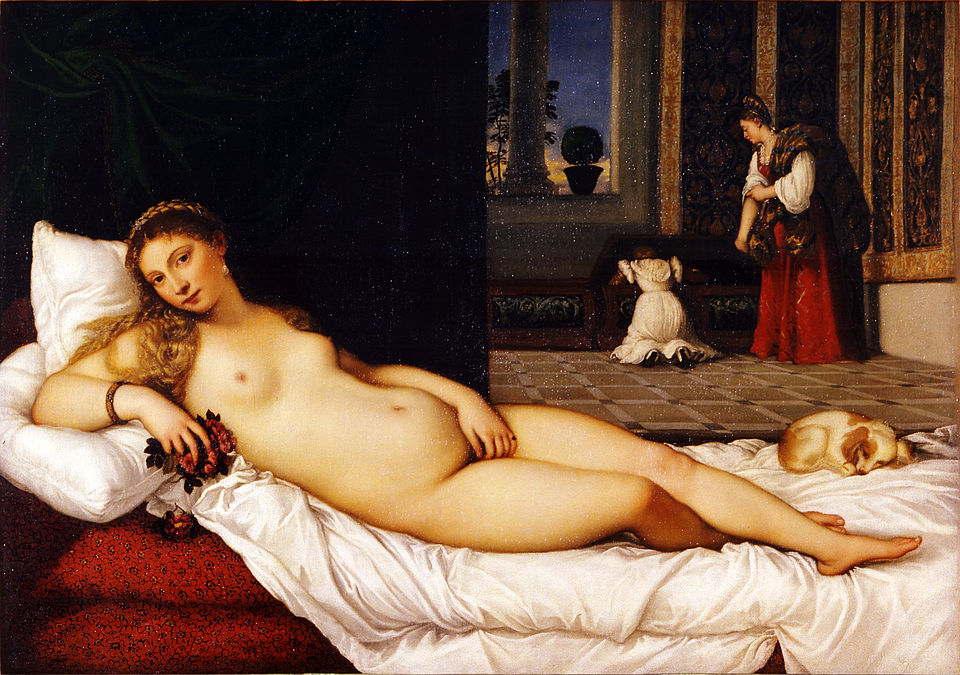
The iconography in this painting expands on the use of and deviation from classical symbols as discussed earlier. Unlike other images depicting Venus, this one lacks excessive ornamentation such as jewelry and roses, seeming more modern for the time. Velazquez focuses more on the reality of the scene, distinct from other painters depicting the same figure who focus on overly embellishing the goddess. An important precedent to The Rokeby Venus is Titian’s Venus of Urbino, which features a reclining, comfortable, and intimate Venus, immediately setting the scene as calm, curious, and confidential. Both paintings hold such sentiments, and Titian’s Venus is a clear inspiration for Velazquez’s, yet in no means a direct copy. Velazquez was likely also inspired by Titian’s mythological series for Philip II, which displayed the female nude in various sensual poses.
As for the social history of The Rokeby Venus, it was painted at a time when art was being heavily policed by the Catholic Church, and the ownership of nudity was strictly forbidden. Because of this, the painting highlights class hierarchies of society and the exemptions rewarded to elites, allowing them to partake in forbidden art in secret cohorts. Royals and court officials would still collect paintings with nudity despite the illegality, and would display them in private rooms off limits to the public. Although secret, these rooms were quite welcoming of high officials and the rich, creating a clear demarcation between who “deserved” to experience art and who did not. Velazquez’s position as royal court painter granted him special protection and permission to create artworks that were illicit. This separated him from other artists who were forced to bend their artistic creativity based on societal scrutiny and law, without means of any loophole. Status is a privilege, as it always was and will be, and the more of it one holds, the more one got away with dodging penalty. Gaspar Méndez de Haro, the 7th Marquess of Carpio, the commissioner of The Rokeby Venus, intended for the painting to be private, which also allowed for Velazquez to paint the female nude without punishment.
In 1997, art historian Peter Cherry suggests Velazquez’s reasons for the rear view, and how he sought to bypass illegality. Velazquez also mitigated societal expectation of artistic themes by how he painted Venus as so unrecognizable. Without being able to distinguish her features properly, her identity is withheld, somewhat maintaining modesty in the painting, instead of creating a blatant “disgrace” to tradition. Moreover, painting Venus nude was perceived more honorable than painting the portrait of a typical nude sitter without the additional classical importance added. The very idea of using a nude model in Spain was unheard of at the time, yet Velazquez conquered the taboo with classic subjects. “Even if the picture were painted during Velázquez’s visit to Italy (1649-51), its idiosyncrasy might be seen as a direct response to inhibitions with regard to depictions of the female nude which prevailed in Spain…The fact that Velázquez’s Venus is painted from a live model may have been one of its most distinguishing and exciting aspects to contemporary eyes. The practice of using nude female models may have been common among artists of the Veneto, but was virtually nonexistent in Spain. Francisco Pacheco (Velazquez’s mentor) recommended that only the heads and hands of chaste women were to be painted from life, and that female bodies should be based on prints and classical sculpture” (Cherry, P., & Burke, M. B., 74). In addition to this, Velazquez employs the “Venus pudica” (modest Venus) archetype used in Western depictions of Venus and similar goddesses to maintain modesty in her nude pose.
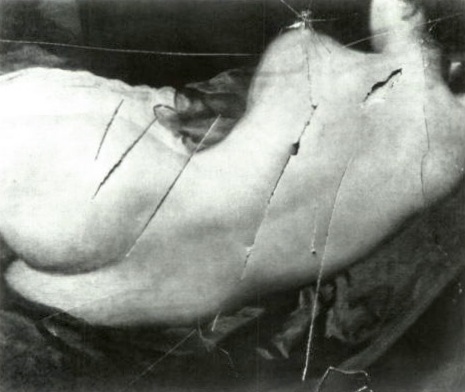
For over 150 years, the painting had not been seen publicly, due to its controversy. After staying in aristocratic collections since 1651, it was moved to England in 1813. Only in 1906 did the painting reach the public eye upon entering the collection of the National Gallery, London. In 1914, feminist suffragette Mary Richardson slashed the painting in protest of the objectification of the female body, which once again reminded the public of its brazenness. Hundreds of years following its creation, the female nude still engenders intense controversy. The varying ways society has held resentment toward it declares a great deal about the specific era. An example would be the attack during the Suffragette movement when the explicitness created conversation once again, not for the sake of male pleasure but for the sake of women, and the objectification the painting depicts.
Velazquez’s Rokeby Venus is filled to the brim with traditional symbolism, yet is still viewed as revolutionary considering the way these icons and well known symbols are strategically displayed in the piece. Along with these ideals reminiscent of classical motifs exist shameless suggestion of modernity and bold innovation. At a time when art was being controlled by the Catholic Church, The Rokeby Venus was able to escape unscathed because of status the artist held, and its classical subject matter. The anger, controversy, and conversation sparked by the painting has not extinguished over time, but continues to evolve based on societal norms and political advancements.
Works Cited:
Bertamini, M., Latto, R., & Spooner, A. (2003). The Venus effect: people’s understanding of mirror reflections in paintings. Perception, 32(5), 593–599. https://doi.org/10.1068/p3418
Cherry, P., & Burke, M. B. (1997). Collections of Paintings in Madrid, 1601–1755. https://www.getty.edu/publications/virtuallibrary/0892364963.html
Epstein, R. (2019). Slashing Signs: Mary Richardson’s attack on “The Rokeby Venus” as semioclasm. JMU Scholarly Commons. https://commons.lib.jmu.edu/madrush/2019/slashing/1/
Fernandez, A. A. (2001). The first owner of the Rokeby Venus. Burlington Magazine/the Burlington Magazine, 143(1175), 91–93. https://dialnet.unirioja.es/servlet/articulo?codigo=725803
Natasha. (2000). Velazquez’s: Venus at her Mirror. https://www.jssgallery.org/Other_Artists/Velazquez/Velazquez_Venus_at_her_Mirror.htm
The National Gallery, London. (n.d.). Diego Velázquez | the Toilet of Venus (‘The Rokeby Venus’) | NG2057 | National Gallery, London. https://www.nationalgallery.org.uk/paintings/diego-velazquez-the-toilet-of-venus-the-rokeby-venus
 Earth As My Guardian