
One of the most eccentric, innovative, and visually appealing art movements in the Western world is Art Nouveau. With its emphasis on nature and liberty from rigid lines and geometry, Art Nouveau is immensely influential on art, design, and architecture. This movement peaked in influence from the 1890s through the 1910s, and developed into Art Deco in the 1920s and 1930s. Although Art Deco accentuated minimalism in practical and domestic design, many remnants of Art Nouveau trickled their way through, and its influence lives on in many of our every day designs.
Prominent Art Nouveau attributes include circular curves, asymmetric, whiplash-like lines, blurry borders, and flowing, airy figures.
Art Nouveau was heavily inspired by Japonisme, a French term expressing the impact of Japanese art on European art, which came about through trade between the two societies.

An essay from the Metropolitan Museum of Art by Colta Feller Ives explains the similarities between these two styles: “Elongated pictorial formats, asymmetrical compositions, aerial perspective, spaces emptied of all but abstract elements of color and line, and a focus on singularly decorative motifs.”
When analyzing Art Nouveau, to focus on the exaggerated female figure, its presence, use of motifs, and its implementation in many pieces of domestic design, is integral. These curves, patterns and designs share messages of femininity, whether through direct implications (such as literal female figures), indirect implications (such as floral patterns, natural picturesque landscapes and soft, pastel-like colors), or the practical uses of such pieces. Femininity is essential to the Art Nouveau aesthetic; ideas drawn from mother nature, fertility, and fragility are highly present.
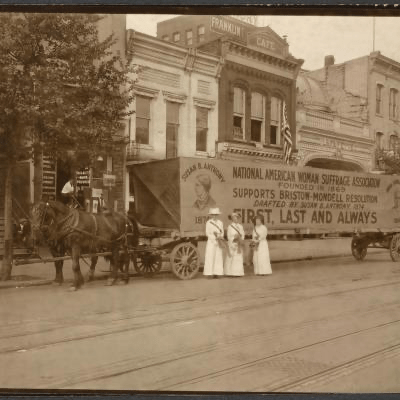
Whether this heavy focus on femininity was an intentional choice of well-known designers such as Alphonse Mucha and Artus Van Briggle, it still can be viewed in such a way that frames femininity as a thematic constant.
The Despondency Vase by Artus Van Briggle stands in as an example of literal female depiction in Art Nouveau. Van Briggle was a well known, highly experienced ceramicist and founder of the Van Briggle Pottery company in 1901. Designed between 1902 and 1905 in Colorado Springs, United States, the vase stands at a mere foot and three quarters of an inch. It was crafted out of earthenware, matte-glazed green, and sits in a glass window behind many similar pieces at the Metropolitan Museum of Art.
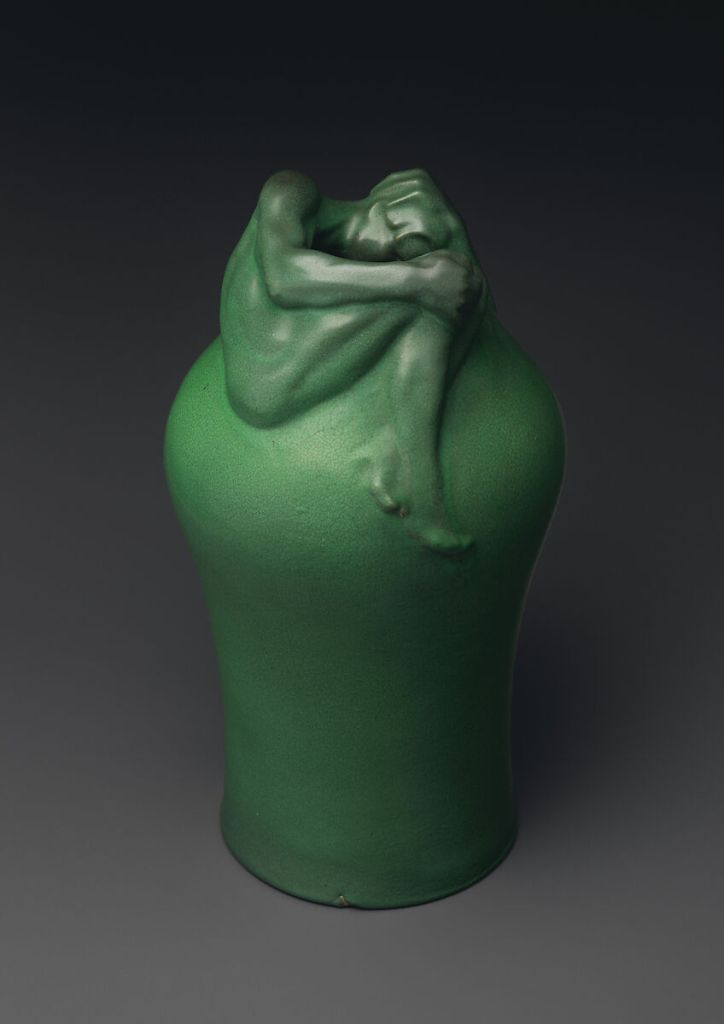
Van Briggle’s infamous matte-glaze leaves a velvety finish, provoking a mood of fragility and delicacy. This aligns perfectly with the figure’s soft and curved body, which seems to bleed right into the vase, its grounding point. The color chosen, a calming, yet monotoned, cold and leafy green, emphasizes the mood of nature, solemnity, silence, and bareness. The colors are read as soft and quiet, not sad or anguished. The figure could be in a state of renewal or perish, loss or redemption. This color specification refrains from depicting these emotions, and rather portrays the overall static mood of the scene.
The vase’s form is unique; while somewhat asymmetric, it still holds visual balance in its presentation and structure. Our eyes are drawn into loops of circles, considering the curves that stem from the body and down throughout its base. The vase’s shape resembles an enlarged chess piece, with a low-relief etching of a figure at the top, known to be a women, considering the nature of Van Briggle’s collection of work and replication of the female figure throughout it. She lays in a fetal position, nude, with her knees held up tight to her forehead, and with her left arm underneath her head. She holds herself gently. Her seemingly lifeless body folds into the vase’s rounded shape, as if blending the two together into a single element.
Even with such an obvious depiction of generic femininity, there is still some deeper analysis to make.
Importantly noted is the struggle faced by women during this historical period, and the forced placement of typical “roles” placed upon them, such as mother, homemaker, and caregiver. Obtaining basic legal rights for women was central to the growing feminist movement during the early twentieth century, which was slowly gaining traction and attention. At the very same time, many women were entering the workforce, yet still worked in horrible conditions with wages far lower than that of their male coworkers. The Despondency Vase simultaneously blends these expectations placed on women, and the mental and physical struggle with reality that they face.
The piece connects women and nature as one, tying in the idea of nature and the esoteric, mother and child, yet still portraying the fatigued, disempowered and subjugated reality forced upon them. Conveyed is a stereotypically described woman of nature depicted in a state of loss and surrender.
The second piece, the Table Lamp with Lotus Shade by Louis Comfort Tiffany, designed from 1905-1915, currently at the MET, is an example of metaphorical depiction of feminine symbolism, drawn from an even deeper and more historically educated analysis than the breakdown of the Despondency Vase.
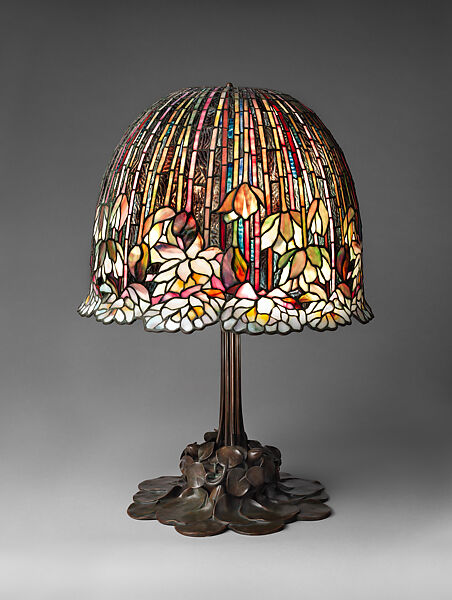
This table lamp, resembling Medieval-styled stained glass windows and architecture, involves bright, vibrant, and eccentric colors of greens, yellows, pinks, and oranges, creating a collage of color and depth. The colors, joined by the light, create visual balance and harmony within the space they hold. Light is allowed to escape the boundaries of the curved flower petal curtained over the bulb, considering the particularity of Tiffany’s Favrile glass made uniquely for Tiffany’s studios. Favrile glass was a term coined by the company itself, and inspired many imitations of art glass, since Favrile glass was highly expensive back when it was first introduced.

The geometric, yet curved shapes outlining the flower petals hold the true form of the Art Nouveau aesthetic, yet also begin to show some signs of Cubism, a primary art movement some years later.
The domelike shape of the lamp is similar to the Despondency Vase; both seem heavily affected by Earth’s gravity and its instinctual pull, with both bases being the center of force. Both subjects, whether it be the woman on the vase or the flower petals dropping from their frail stems, seem involuntarily succumbed to their natural doom, connecting them back with their ancestors within the earth itself.
The connection to femininity seems obvious; the colors used have hints and hues parallel to ones coupled with femininity, and is designed with flowers such as lilies and peonies, often associated with the feminine aesthetic. However, the practical use and creation of the lamp emphasizes these connections more drastically. Lamps are usually placed in female dominated areas of the home, such as living rooms and bedrooms, immediately tying both women, these lamps, and their locations into the same equation. To add onto this, Tiffany lamps were often seen in elite homes, emphasizing a woman’s role in beauty and caretaking more than ever.
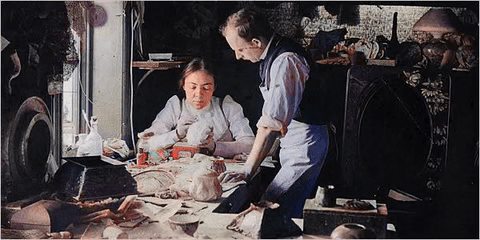
A major aspect of the actual production of Tiffany lamps involved a group called the “Tiffany Girls”; the real working and performing artisans in Tiffany’s studios, and an example of the very few women actually allowed to work in decorative studios.
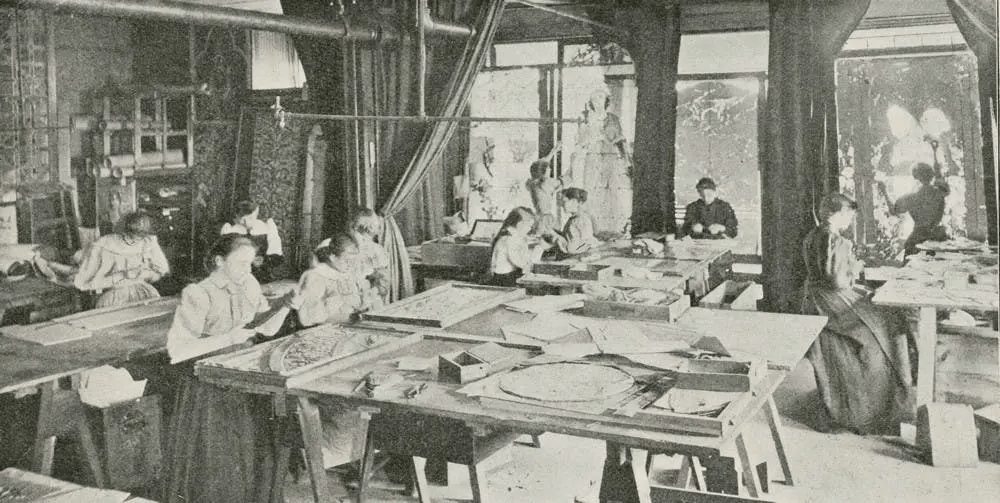
These special, unrecognized women are responsible for many designs that Tiffany pumped out within the years of its prime, with recognition still being wrongfully attributed. Clara Driscoll, the leader of the Tiffany Girls, designed many of Tiffany’s most famous lamps, such as the Wisteria, Daffodil, and Peony lamps that were accredited to Louis Comfort Tiffany up until the late twentieth century.

Within these and many other studios, most of the work was done by women, and was belittled despite being the segment of the production line with the most refined, detailed and intricate skillset yet.
These two different pieces created at relatively similar times within design culture share motifs of the feminine and its connection to nature, either as a promise or a threat, and are depicted and analyzed in quite separate ways. The Despondency Vase shows a female figure grounded, quite literally, within nature, while still conveying society’s current mental and physical state of femininity.
The Table Lamp with Lotus Shade depicts an untold story rather than a perceived reality, and more affectively portrays the female struggle considering its historical context. The vase superficially depicts this very same struggle in a literal sense, while still being crafted by men. Visually, the vase depicts this struggle more affectively, but the lamp characterizes as more inherently feminine considering its background and creators.
 Earth As My Guardian